

Part 1. How Artificial Intelligence Began: The History of AI Before Neural Networks
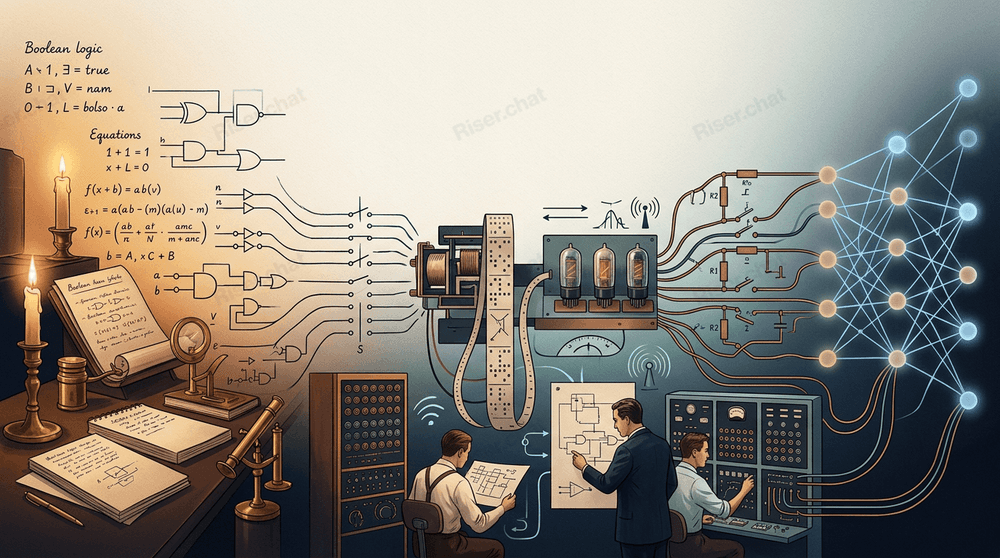
Artificial intelligence can now hold conversations, write code, analyze documents, and generate images. With the rapid rise of ChatGPT, Claude, Gemini, and other AI systems, it is easy to assume that neural networks appeared almost overnight.
They did not.
The history of artificial intelligence began long before modern computers. Its foundations were laid by philosophers, mathematicians, engineers, logicians, and brain researchers who asked remarkably modern questions:
- Can human reasoning be expressed as a set of formal rules?
- Can a machine solve problems associated with intelligence?
- Can the brain be represented as a computational system?
- What separates intelligent behavior from automatic behavior?
- Can a system improve by learning from its mistakes?
To understand how neural networks emerged, we need to return to an era before the internet, microprocessors, or even the term artificial intelligence.
The short answer: when was artificial intelligence invented?
Artificial intelligence emerged as a distinct academic field in 1956, during the Dartmouth Summer Research Project on Artificial Intelligence. John McCarthy helped organize the workshop and introduced the term that would define the new field. The participants explored whether learning, reasoning, and other aspects of intelligence could be described precisely enough for machines to simulate them.
The foundations of AI, however, are much older. During the nineteenth and early twentieth centuries, researchers developed:
- mathematical logic;
- Boolean algebra;
- probability theory;
- automata theory;
- mathematical models of the nervous system;
- feedback and control theory;
- programmable computing machines.
For this reason, there is no single answer to the question “Who invented artificial intelligence?” AI emerged from the convergence of several scientific disciplines rather than from one isolated invention.
The dream of a mechanical mind
Humans imagined artificial beings long before they could build computers. Ancient myths described living statues, mechanical servants, and artificial creatures. Later inventors constructed elaborate automata that could move, play music, or imitate handwriting.
These machines were impressive, but they were not intelligent. They followed predetermined sequences of mechanical actions.
The real turning point came when philosophers and mathematicians began treating reasoning not as an unexplained mystical force, but as a sequence of operations.
If reasoning follows rules, those rules may be written down. If they can be written down, perhaps a machine can execute them.
This idea became one of the essential foundations of artificial intelligence.
Turning human reasoning into formal logic
Logic dates back to antiquity, but for centuries it remained largely a branch of philosophy. It helped people distinguish valid arguments from invalid ones, yet it was not a language that could easily be implemented in a machine.
That began to change in the nineteenth century with the development of mathematical logic.
George Boole and the algebra of reasoning
English mathematician George Boole developed a system in which logical reasoning could be represented through mathematical operations. A statement could have one of two values:
- true;
- false.
These values could be processed using operations such as:
- AND — both conditions must be true;
- OR — at least one condition must be true;
- NOT — the value is reversed.
Consider a simple rule:
If the user has an account AND enters the correct password, grant access.
For a person, this is an ordinary condition. For a digital computer, it can be represented as an operation involving 0 and 1.
Boole did not have an electronic computer on which to implement his system. Nevertheless, Boolean algebra later became one of the mathematical foundations of digital computing.
From reasoning to algorithms
The importance of mathematical logic went beyond formulas. It showed that at least some forms of human reasoning could be represented formally.
Instead of telling a machine to “think about the problem,” a designer could specify:
- the initial information;
- the rules for processing it;
- the order of operations;
- the condition for producing an answer.
This is the basic idea behind an algorithm. A recipe, a formal proof, and a computer program all share a common structure: input, rules, operations, and output.
Logical methods would later become central to early AI research, particularly in systems that attempted to reproduce intelligent behavior through explicitly defined symbols and rules.
Claude Shannon: turning logic into electrical circuits
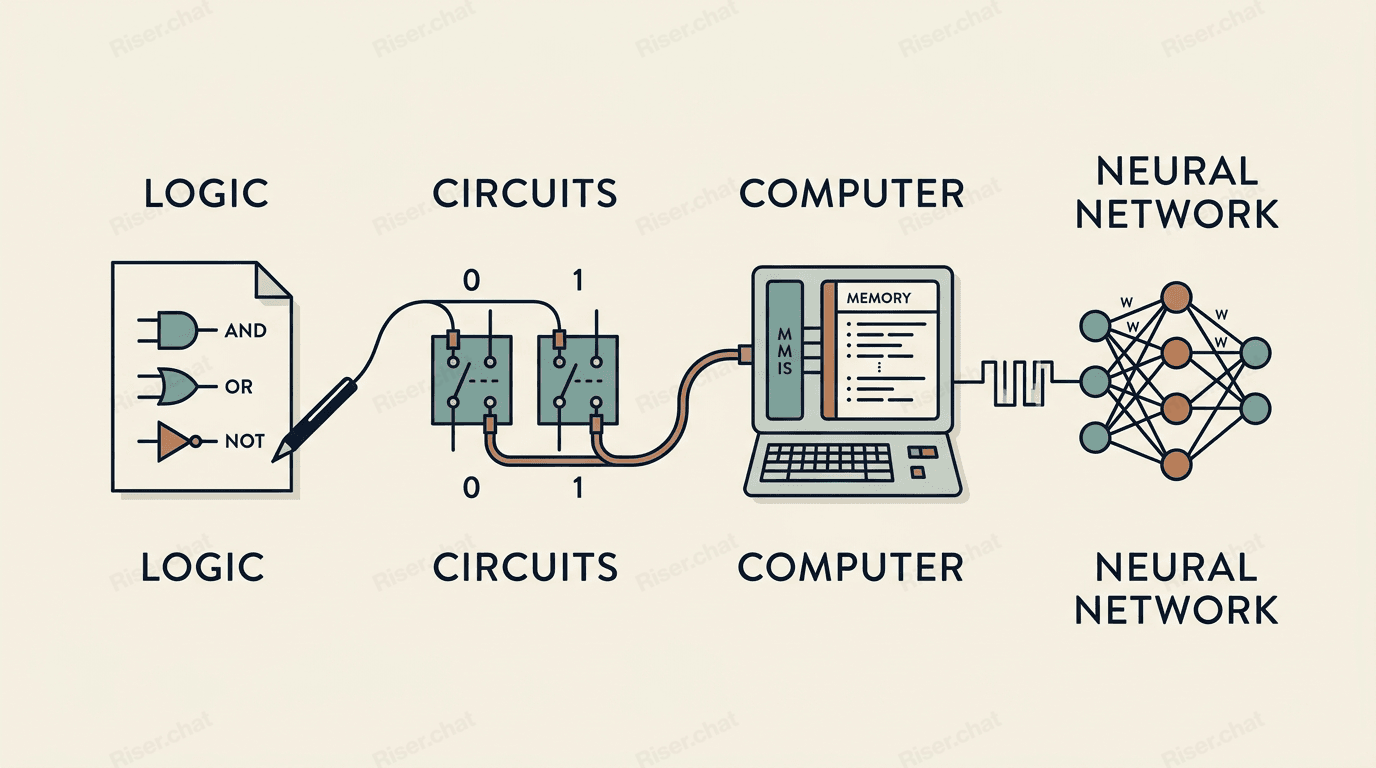
Boolean algebra might have remained an abstract mathematical tool if engineers had not discovered how to implement logical operations in physical machines.
A major breakthrough came from Claude Shannon. In his 1937 master’s thesis, Shannon demonstrated that Boolean algebra could be used to describe networks of electrical relays.
A relay or switch has two basic states:
- open;
- closed.
These states can be represented as:
0;1.
By connecting switches in different arrangements, engineers could construct circuits that performed the logical operations AND, OR, and NOT.
Shannon therefore connected three previously separate ideas:
mathematical logic → electrical switches → digital computation.
This principle became fundamental to modern computing. Today’s processors are vastly more advanced than relay-based machines, but they still perform enormous numbers of elementary logical operations.
Could the brain be understood as a computing system?
While mathematicians were formalizing logic, neuroscientists were studying the structure of the human brain.
By the early twentieth century, scientists understood that the nervous system consisted of vast numbers of cells called neurons. Neurons receive signals, process them, and transmit new signals to other cells. How this electrical activity produces memory, perception, and thought, however, remained unclear.
A crucial idea for the future history of neural networks was that a neuron might be represented as a simplified computational unit:
- it receives several input signals;
- it combines those inputs;
- it produces an output after a threshold is reached.
A biological neuron is far more complicated than this model. But a mathematical model does not need to reproduce every detail of a living cell. It only needs to represent the properties relevant to a particular problem.
This led researchers toward a powerful hypothesis:
Complex thought might emerge from the interaction of many relatively simple elements.
In 1943, Warren McCulloch and Walter Pitts published a mathematical model of an artificial neuron. Their work is often treated as the beginning of the formal history of artificial neural networks.
Alan Turing and the universal machine
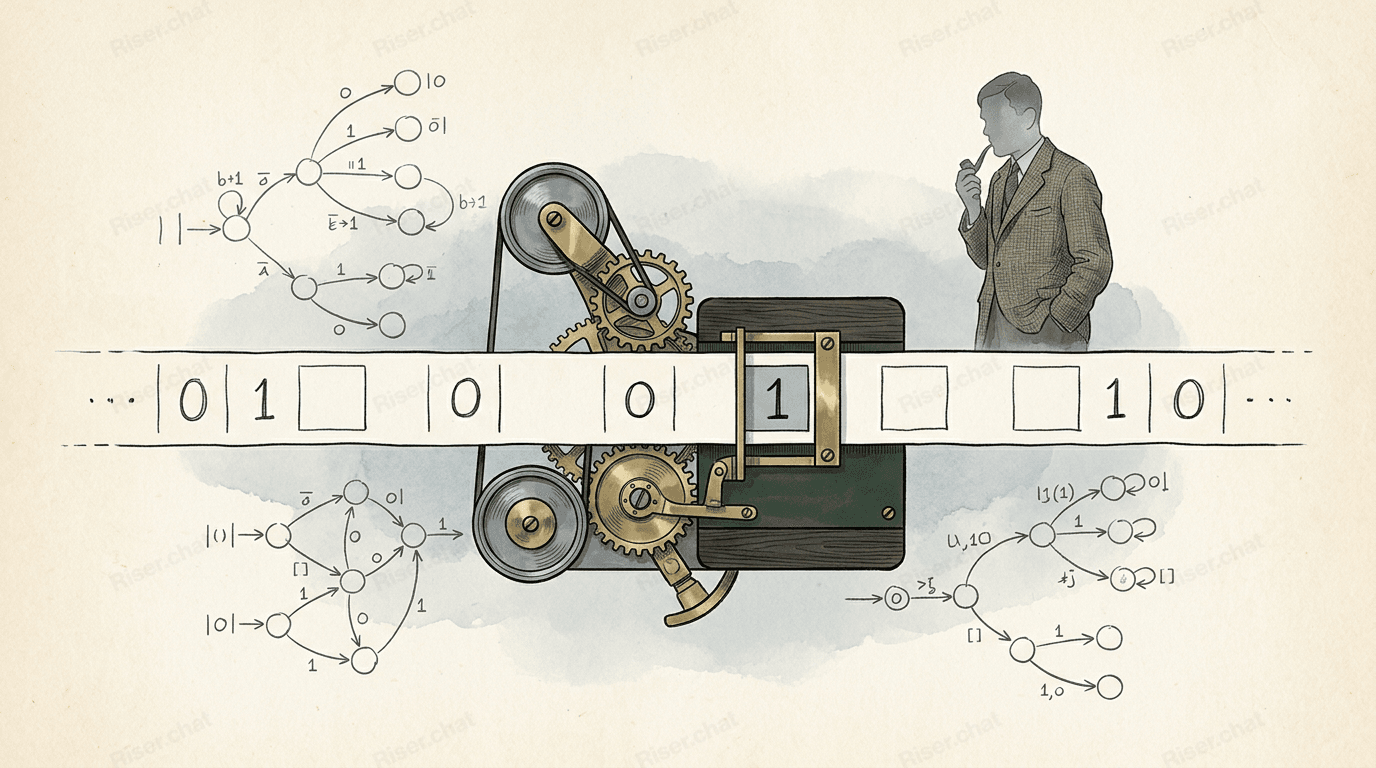
British mathematician Alan Turing was another central figure in the origins of artificial intelligence.
During the 1930s, Turing proposed an abstract model of computation now known as the Turing machine. It was not a specific physical device. Instead, it was a conceptual machine designed to define what computation actually means.
A simplified Turing machine includes:
- a tape containing symbols;
- a mechanism for reading and writing;
- a set of internal states;
- rules that determine the next action.
Despite its simplicity, the model can describe any algorithmic computation, provided that enough time and memory are available.
The revolutionary idea was that one universal machine could perform many different tasks simply by receiving different instructions. Today, this seems natural: the same laptop can run a browser, a video editor, a game, or an AI model. Early computing devices, however, were often designed for one narrowly defined task.
Turing helped separate the physical machine from the program. A new task did not always require a new machine; sometimes it only required a new set of instructions.
Can machines think?
In 1950, Turing published Computing Machinery and Intelligence, a paper addressing the possibility of machine intelligence.
Instead of attempting to define the word thinking, he proposed evaluating a machine through conversation. In what later became known as the Turing test, a human judge communicates with unseen participants. If the judge cannot reliably determine which participant is a machine, the machine has demonstrated convincing intelligent behavior.
Turing did not prove that successful imitation would resolve every philosophical question about consciousness. He offered a practical way to discuss intelligence through observable behavior.
The experiment feels especially relevant today. Large language models can hold remarkably natural conversations, but producing convincing text does not necessarily mean that they possess human consciousness or think in the same way humans do.
The arrival of programmable computers
Mathematical theories alone could not create artificial intelligence. Researchers also needed real machines on which they could test their ideas.
Computer development accelerated during the first half of the twentieth century. Cryptography, military calculations, ballistics, and scientific research created demand for devices capable of performing large numbers of calculations quickly.
Early electronic computers were enormous, expensive, and unreliable by modern standards. Programs might be entered using switches, cables, punch cards, or paper tape. A machine could fill an entire room while having less memory than the smallest device in a modern household.
Even so, these computers introduced a fundamental change: mathematical operations could now be performed automatically and at high speed.
John von Neumann and stored programs
Mathematician John von Neumann played an influential role in the development of general-purpose computing. His name is associated with an architecture in which both program instructions and data are stored in the computer’s memory.
In simplified form, such a computer includes:
- a processor;
- memory;
- input devices;
- output devices;
- a sequence of stored instructions.
Earlier machines often required physical reconfiguration to perform a new task. Cables had to be moved or switches rearranged. The stored-program concept made it possible to load new instructions into memory without rebuilding the entire machine.
This transformed the computer into a universal tool. The same hardware could perform calculations, process text, simulate physical systems, and run early experiments in machine intelligence.
Automata theory: behavior as a sequence of states
Automata theory provided another bridge between mathematics and artificial intelligence.
In this context, an automaton is not necessarily a robot. It is an abstract system that:
- begins in a particular state;
- receives an input;
- follows a rule;
- moves into a new state;
- produces an output when required.
A subway turnstile offers a simple example:
- current state: locked;
- input: valid payment;
- new state: unlocked;
- next input: a person passes through;
- new state: locked again.
Similar principles can describe programs, digital devices, communication systems, and the behavior of artificial agents.
Automata theory helped researchers formulate an important question: how much complex behavior can emerge from simple rules and state transitions? That question would become central to computer science, robotics, and AI.
Norbert Wiener and the birth of cybernetics
Logic studied the rules of reasoning, while computing focused on executing operations. Cybernetics concentrated on communication, control, and feedback.
The term became widely known through American mathematician Norbert Wiener, who published Cybernetics: Or Control and Communication in the Animal and the Machine in 1948.
Wiener was interested in the similarities between living organisms and technical systems. Both can:
- receive information from their environment;
- compare their current state with a desired state;
- adjust their actions;
- use the results of previous actions.
The central concept was feedback.
What is feedback?
Consider a thermostat:
- the user sets a desired temperature;
- a sensor measures the current temperature;
- the system compares the two values;
- it turns the heating on or off;
- a new measurement reveals the result.
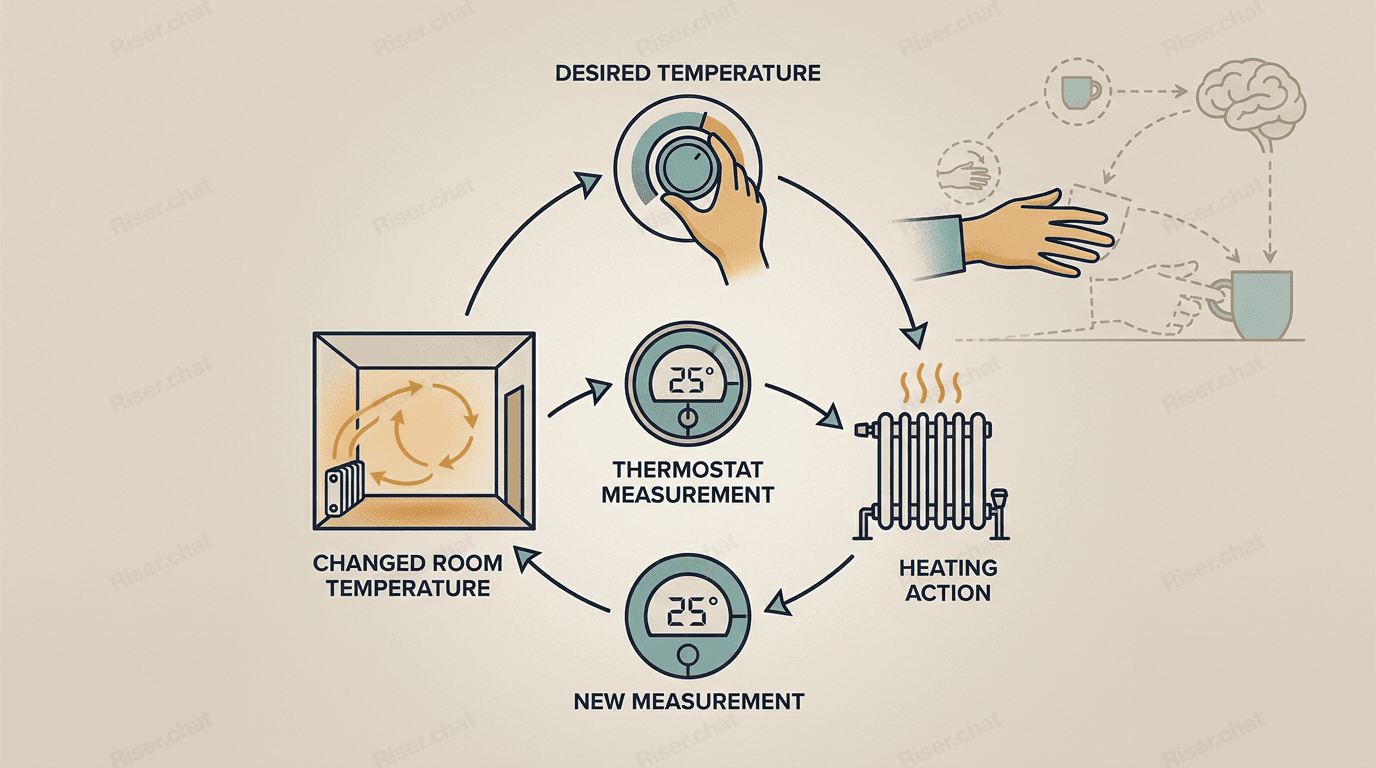
The system does not merely execute one fixed command. It continuously receives information about the consequences of its actions and adjusts its behavior.
A similar process occurs in living organisms. When a person reaches for a cup, the brain receives constant information from vision and the muscles. If the cup is farther away than expected, the hand changes its path.
Cybernetics brought together the study of communication and control in machines, organisms, and other complex systems. Feedback became a foundational concept in automation and control theory.
Cybernetics and AI are not the same thing
The fields are closely related, but they are not synonyms.
Cybernetics studies control, communication, and feedback across different kinds of systems.
Artificial intelligence focuses on systems that perform tasks associated with perception, learning, reasoning, planning, or language.
Cybernetics contributed a critical idea to AI: a machine does not have to follow instructions blindly. It can alter its behavior based on information about previous results.
The same principle can be seen in neural network training. A model makes a prediction, compares it with the desired output, receives an error signal, and adjusts its internal parameters.
Probability and reasoning under uncertainty
Formal logic works well with precise statements:
- a condition is either satisfied or not;
- a proposition is either true or false;
- a signal is either zero or one.
The real world is rarely so clear.
A doctor may not be able to identify a disease from one symptom with absolute certainty. A driver cannot know for sure whether a pedestrian will enter the road. A listener may be uncertain about what a speaker intended to say.
Probability theory and statistics provided tools for dealing with this uncertainty. They made it possible to ask:
- How likely is an event?
- Which explanation best fits the available evidence?
- How should a prediction change when new information appears?
- How confident should we be in a result?
Modern neural networks also rely on probabilities. A language model does not retrieve every response from a hidden collection of completed answers. It estimates which tokens are likely to form an appropriate continuation of the current sequence.
The history of AI is therefore not only a history of formal logic. It is also a history of methods for making predictions and decisions with incomplete information.
Why mathematics mattered more than fictional robots
Artificial intelligence has long been represented by mechanical humans and metallic robots. Even today, articles about AI are frequently illustrated with glowing humanoid faces.
The actual history of AI followed a very different path.
Its most important building blocks were abstract concepts:
- logical expressions;
- algorithms;
- probabilities;
- states;
- signals;
- feedback;
- memory;
- programs;
- mathematical models of neurons.
Engineers did not need to build an artificial body before they could create an intelligent system. First, they needed to determine which parts of intelligent behavior could be represented as information processing.
For this reason, the direct ancestors of ChatGPT were not humanoid automata. They were mathematical logic, probability theory, the theory of computation, cybernetics, and programmable computers.
A modern language model does not resemble a person. It exists as software and a vast collection of numerical parameters. Yet it continues an old scientific idea: certain aspects of intelligent behavior can be described precisely enough for a machine to reproduce them.
Where does the history of artificial intelligence begin?
There is no single starting point. The answer depends on how AI is defined.
If we begin with the dream of a mechanical mind
The story reaches back to ancient myths, philosophy, and early mechanical automata.
If we begin with the formalization of reasoning
The nineteenth-century work of George Boole becomes a major starting point.
If we begin with computation theory
The story begins in the 1930s with Alan Turing’s work on computability and universal machines.
If we begin with artificial neurons
The history of neural networks starts in 1943 with the McCulloch–Pitts model.
If we mean AI as an academic discipline
The most widely accepted date is 1956, when the Dartmouth Summer Research Project helped establish artificial intelligence as a distinct field. The project was proposed by John McCarthy, Marvin Minsky, Nathaniel Rochester, and Claude Shannon.
Artificial intelligence was not invented on one particular day. It gradually emerged at the intersection of several disciplines.
From logic and cybernetics to neural networks
The journey from Boolean algebra to ChatGPT took many decades, but its central ideas form a clear sequence:
- Logic showed that reasoning could be represented through formal rules.
- Boolean algebra provided a mathematical language for true and false statements.
- Claude Shannon connected logical operations with electrical circuits.
- Computation theory defined what universal programmable machines could do.
- Brain research inspired networks of interacting computational elements.
- Automata theory represented behavior through states and transitions.
- Cybernetics emphasized information, control, and feedback.
- Probability theory provided tools for reasoning under uncertainty.
- Early computers made it possible to test these ideas experimentally.
- Mathematical neurons opened the path toward trainable neural networks.
ChatGPT and other modern AI systems were not made possible by one sudden discovery. They emerged from the combined work of mathematicians, engineers, logicians, neuroscientists, and control theorists.
Key people and their contributions
| Researcher | Major contribution |
|---|---|
| George Boole | Developed an algebra of logical operations |
| Alan Turing | Created a theoretical model of computation and explored machine intelligence |
| Claude Shannon | Connected Boolean logic with electrical switching circuits |
| John von Neumann | Helped establish stored-program computer architecture |
| Norbert Wiener | Developed cybernetics and feedback theory |
| Warren McCulloch | Co-created an early mathematical model of an artificial neuron |
| Walter Pitts | Helped formalize the logical behavior of neural networks |
| John McCarthy | Introduced the term “artificial intelligence” and organized the Dartmouth project |
A brief AI history timeline
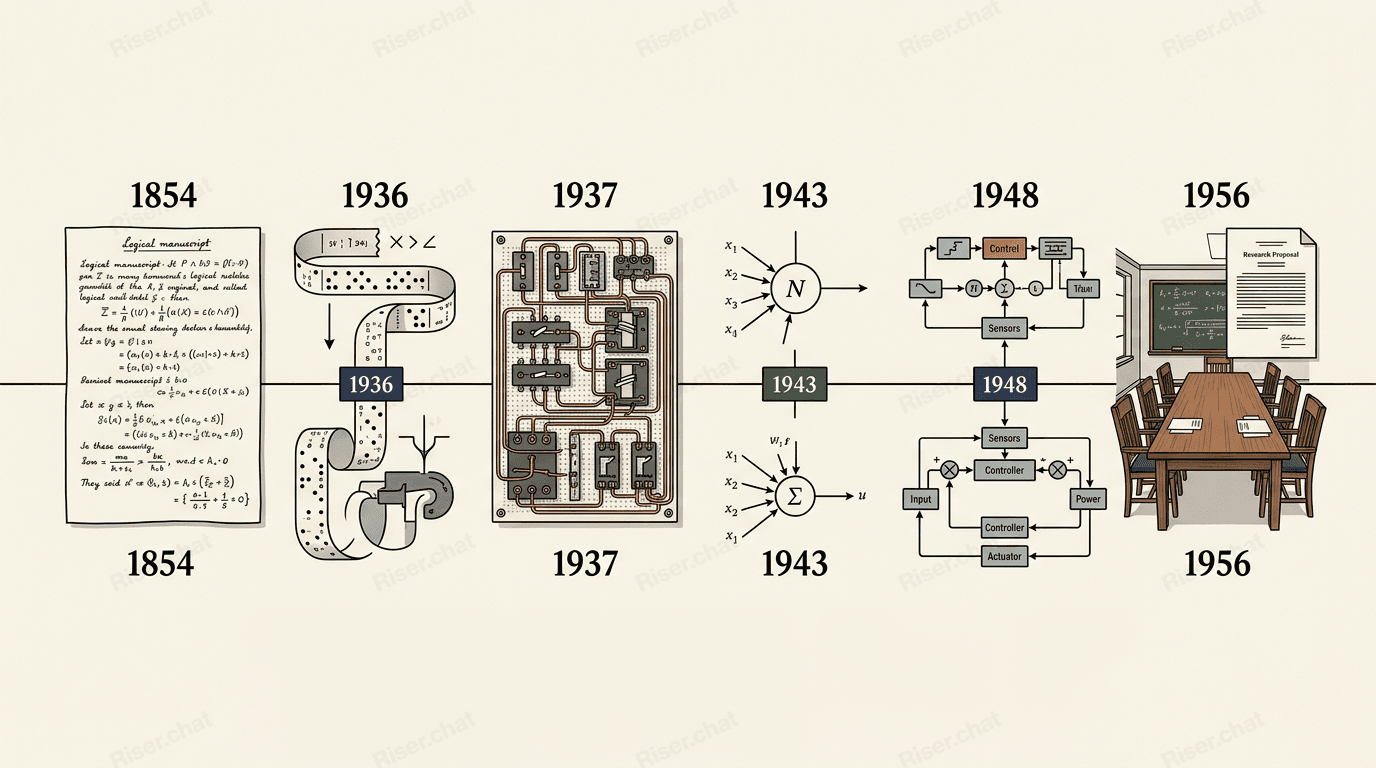
| Year | Event |
|---|---|
| 1854 | George Boole systematizes the algebra of logical operations |
| 1936 | Alan Turing describes a theoretical model of computation |
| 1937 | Claude Shannon connects Boolean algebra with relay circuits |
| 1943 | McCulloch and Pitts introduce a mathematical neuron model |
| 1940s | Early electronic computers are developed |
| 1948 | Norbert Wiener publishes his foundational book on cybernetics |
| 1950 | Turing publishes his paper on computing machinery and intelligence |
| 1956 | The Dartmouth project establishes AI as a distinct research field |
Frequently asked questions
Who invented artificial intelligence?
No single person invented AI. John McCarthy introduced the term, while George Boole, Alan Turing, Claude Shannon, Norbert Wiener, John von Neumann, Warren McCulloch, Walter Pitts, and many others developed its scientific foundations.
When did artificial intelligence begin?
AI became a distinct academic field in 1956 at the Dartmouth Summer Research Project. Its mathematical foundations, however, had been developing since at least the nineteenth century.
Did cybernetics come before artificial intelligence?
Cybernetics became widely recognized after Norbert Wiener published his foundational book in 1948. The term artificial intelligence appeared later, in the mid-1950s.
How are cybernetics and AI connected?
Cybernetics studies communication, control, and feedback. Its ideas influenced automation, robotics, adaptive systems, and learning methods used in AI.
How is logic connected to modern computers?
Logical values can be represented as zeros and ones. Operations such as AND, OR, and NOT can be implemented using electronic circuits. Modern processors are built from vast numbers of components performing these operations.
Why did neural network history begin with brain research?
Scientists proposed that a biological neuron could be simplified into a mathematical unit that receives inputs and produces an output. Networks of these units became the foundation of artificial neural networks.
Is ChatGPT real artificial intelligence?
ChatGPT is an artificial intelligence system built on a large language model. It can process language and perform many useful tasks, but this does not mean it thinks or possesses consciousness in the same way a human does.
Conclusion
The history of artificial intelligence did not begin with ChatGPT or even with the first electronic computers. Its origins lie in attempts to formalize human reasoning, understand the nervous system, construct universal computing machines, and create systems capable of using feedback.
George Boole transformed logic into algebra. Claude Shannon showed how logic could be implemented in electrical circuits. Alan Turing defined the principles of universal computation and asked whether machines could display intelligence. John von Neumann contributed to the development of programmable computer architecture, while Norbert Wiener united communication, control, and feedback under cybernetics.
The next step was to transform a neuron from the living brain into a mathematical model. In 1943, Warren McCulloch and Walter Pitts proposed an artificial neuron capable of performing elementary logical operations.
That work begins the next chapter: the history of artificial neural networks.
Modern AI models share common scientific foundations, but their training, behavior, and capabilities differ. Riser lets users work with several models in one interface and compare their answers on real tasks.
Sources and further reading
- George Boole — An Investigation of the Laws of Thought
- Stanford Encyclopedia of Philosophy — Logic and Artificial Intelligence
- Claude Shannon — A Symbolic Analysis of Relay and Switching Circuits
- Computer History Museum — How Do Digital Computers “Think”?
- Alan Turing — On Computable Numbers, with an Application to the Entscheidungsproblem
- Alan Turing — Computing Machinery and Intelligence
- John von Neumann — First Draft of a Report on the EDVAC
- Computer History Museum — The Stored Program
- Warren McCulloch and Walter Pitts — A Logical Calculus of the Ideas Immanent in Nervous Activity
- Norbert Wiener — Cybernetics: Or Control and Communication in the Animal and the Machine
- John McCarthy, Marvin Minsky, Nathaniel Rochester, and Claude Shannon — A Proposal for the Dartmouth Summer Research Project on Artificial Intelligence
- Dartmouth College — Artificial Intelligence Coined at Dartmouth