

Part 2. What Is Cybernetics? Feedback, Control, AI, and Neural Networks Explained
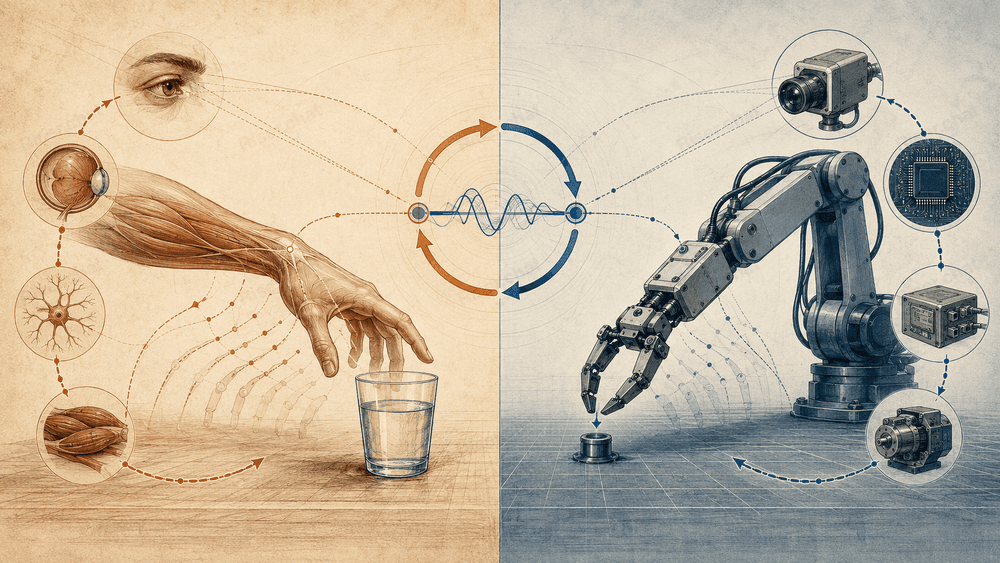
A thermostat maintains a desired temperature. An autopilot corrects an aircraft’s course. A person adjusts the movement of their hand when reaching for an object. A robot changes direction after detecting an obstacle.
These examples belong to different fields, but they share the same basic pattern:
- a system receives information;
- it compares its current state with a desired state;
- it selects an action;
- it measures the result;
- it makes corrections when necessary.
The study of such processes is called cybernetics.
Cybernetics is an interdisciplinary field concerned with control, communication, information, and feedback in machines, living organisms, and other complex systems.
The term may sound slightly old-fashioned today. We are more likely to talk about artificial intelligence, computer science, robotics, machine learning, and control theory. In the mid-twentieth century, however, many of the ideas behind these disciplines were discussed under the much broader label of cybernetics.
The short answer: what is cybernetics?
Cybernetics is the study of how systems use information, communication, and feedback to control their behavior.
Its central idea is that a system can use information about the results of its actions to decide what to do next.
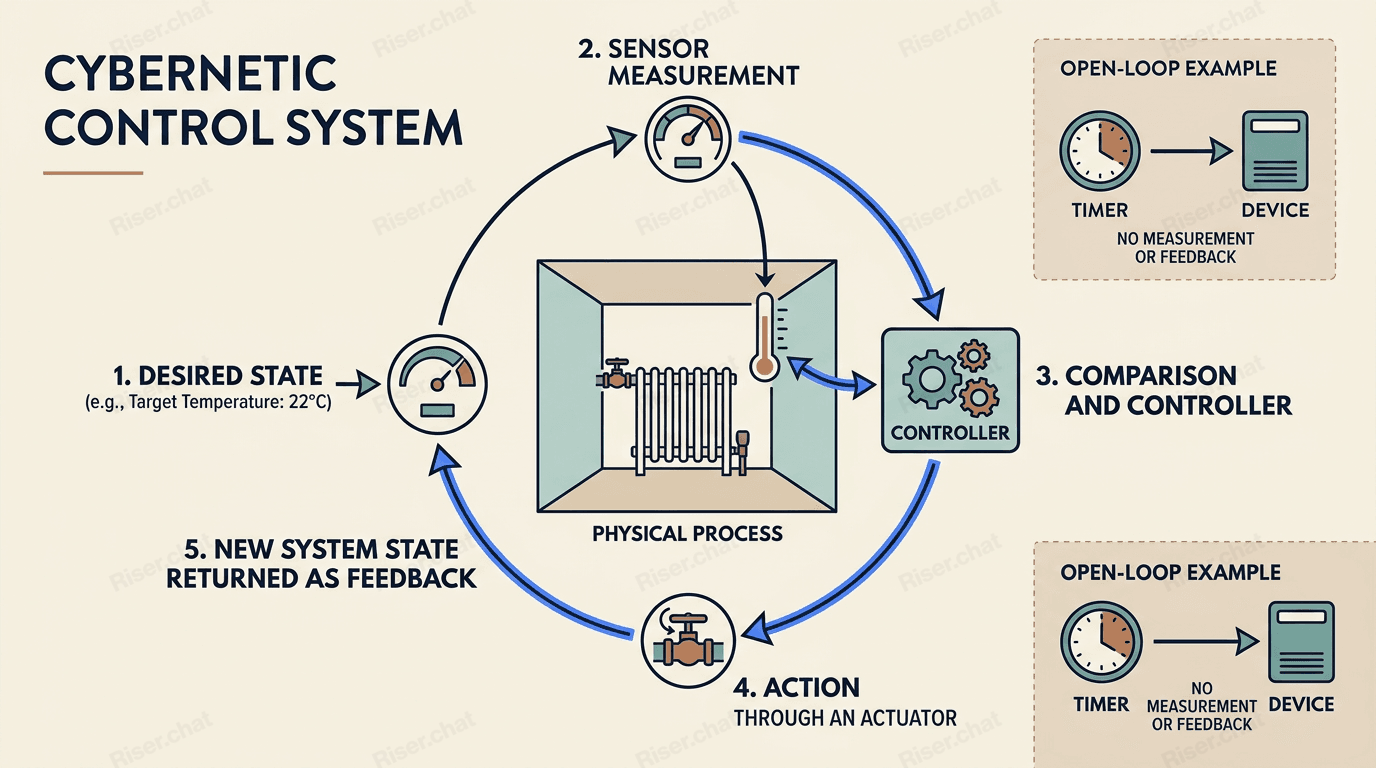
A heating system offers a simple example:
- a target temperature is selected;
- a sensor measures the actual temperature;
- the system compares the two values;
- heating is increased or reduced;
- the temperature is measured again.
Cybernetics is not primarily concerned with the physical construction of the radiator. It examines the general control pattern:
goal → measurement → comparison → action → result → new measurement.
The same pattern can appear in machines, organisms, robots, production systems, and learning agents.
What did cybernetics mean in the mid-twentieth century?
During the 1940s, 1950s, and 1960s, cybernetics covered a much wider range of research than the term usually does today.
It brought together ideas from:
- automatic control;
- information theory;
- computing;
- neurophysiology;
- mathematical biology;
- pattern recognition;
- machine translation;
- robotics;
- adaptive systems;
- artificial intelligence;
- organizational management;
- economic modeling.
Cyberneticians approached a machine, organism, or organization as a system that receives signals, processes information, acts, and responds to the consequences of its actions.
In their influential 1955 paper, Soviet scientists Sergei Sobolev, Anatoly Kitov, and Alexey Lyapunov described cybernetics as a field concerned with control and communication in automatic machines and living organisms. They identified information theory, electronic computers, and feedback-based control systems as some of its central areas.
This provided engineers, mathematicians, physiologists, and computer researchers with a shared language.
A thermostat and an animal are clearly not built in the same way. Yet both may detect changes, compare conditions with an internal requirement, and produce corrective responses. Cybernetics focused on this functional similarity.
Where did the word “cybernetics” come from?
The term is derived from an ancient Greek word associated with a steersman or the art of steering a ship.
A steersman cannot turn the wheel once and ignore the vessel. They must continuously observe the direction of travel, the wind, the current, and the ship’s position. The course is corrected as new information arrives.
This is a useful metaphor for a cybernetic system:
- it has a goal;
- it has a current state;
- it experiences external disturbances;
- it has a control mechanism;
- it makes repeated corrections.
The French physicist and mathematician André-Marie Ampère used a related term in the nineteenth century for the study of government. Its modern scientific meaning was established by American mathematician Norbert Wiener.
Who founded cybernetics?
Norbert Wiener is commonly described as the founder of modern cybernetics.
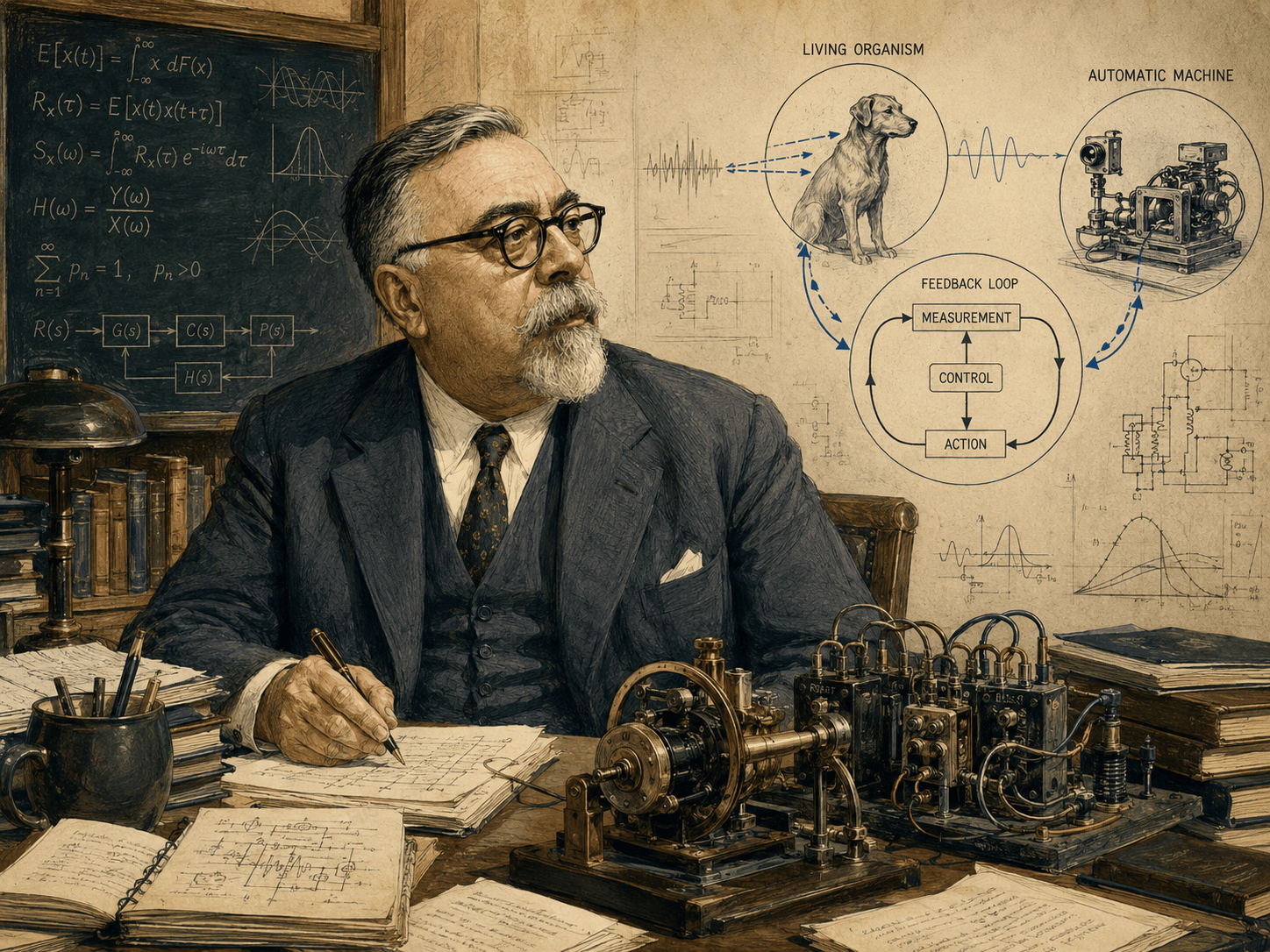
A professor of mathematics at the Massachusetts Institute of Technology, Wiener published Cybernetics: Or Control and Communication in the Animal and the Machine in 1948.
The book brought together control, communication, probability, physiology, computing, and feedback in one interdisciplinary framework.
Cybernetics was not the invention of one person, however. It developed through collaboration among researchers from several disciplines:
- Norbert Wiener worked on communication, control, and stochastic processes;
- Arturo Rosenblueth studied physiology and behavior;
- Julian Bigelow contributed engineering expertise;
- Claude Shannon developed mathematical information theory;
- Warren McCulloch and Walter Pitts modeled neural activity mathematically;
- W. Ross Ashby studied adaptation and self-regulating systems;
- John von Neumann explored computers and self-reproducing automata.
Wiener is best understood as the researcher who unified many of these ideas, established a recognizable scientific program, and gave the field its modern name.
An important paper before Wiener’s book
In 1943, Arturo Rosenblueth, Norbert Wiener, and Julian Bigelow published Behavior, Purpose and Teleology.
The paper proposed studying objects through the relationship between their inputs and outputs. It described purposeful behavior as behavior directed toward a goal and examined how feedback could reduce the difference between a system’s current condition and its target.
This was a crucial step toward cybernetics. Machines and organisms did not need to share the same internal construction to be compared as systems of control.
Control from a cybernetic perspective
In everyday language, control may mean issuing a command:
Press a button, and the machine follows the instruction.
Cybernetic control requires something more. The system must account for what happens after the command is issued.
Consider a drone that needs to maintain a particular altitude. Supplying constant power to its motors would not be enough. Wind, battery charge, payload, and air pressure could all change the result.
A more reliable system operates as a loop:
- the desired altitude is selected;
- a sensor measures the actual altitude;
- a controller calculates the difference;
- motor power is adjusted;
- the altitude is measured again;
- the cycle continues.
Control is no longer a single instruction. It becomes an ongoing process.
Basic elements of a cybernetic system
| Element | Function | Example |
|---|---|---|
| Goal | Defines the desired state | Temperature of 22°C |
| Sensor | Measures the current state | Thermometer |
| Communication channel | Carries information | Electrical signal |
| Controller | Compares the current and desired states | Electronic control unit |
| Actuator | Changes the system | Heater or air conditioner |
| Controlled object | The process being managed | Room temperature |
| Feedback | Reports the new result | Updated temperature reading |
A cybernetic system may be mechanical, electronic, biological, or software-based. Its materials are less important than its flow of information and control structure.
Feedback explained in simple terms
Feedback is information about the result of an action that influences the system’s next action.
Imagine a person filling a glass with water:
- they open the tap;
- they watch the water level rise;
- they reduce the flow;
- they close the tap before the glass overflows.
If the person closes their eyes, the task becomes more difficult. The physical action has not changed, but an important feedback channel has disappeared.
Feedback can take many forms:
- temperature;
- pressure;
- speed;
- distance;
- position;
- sound;
- electrical voltage;
- prediction error;
- user evaluation;
- reward or penalty.
The essential feature is that information about a state or result returns to the control process.
Open-loop and closed-loop control
The importance of feedback becomes clearer when we compare two kinds of control systems.
Open-loop control
An open-loop system executes a command without measuring the actual result.
A basic garden timer might:
- turn the water on at a scheduled time;
- run for ten minutes;
- turn the water off;
- ignore whether the soil is dry or whether it is raining.
The command is completed, but the outcome is not evaluated.
Closed-loop control
A closed-loop system measures the outcome and uses it to adjust its behavior.
A more advanced irrigation system might:
- measure soil moisture;
- compare it with a target value;
- activate the water;
- continue measuring;
- stop when the target is reached.
A closed loop allows the system to respond to real conditions. In an open-loop system, the output does not modify the control action. In a closed-loop system, information about the result is returned to the controller.
Negative and positive feedback
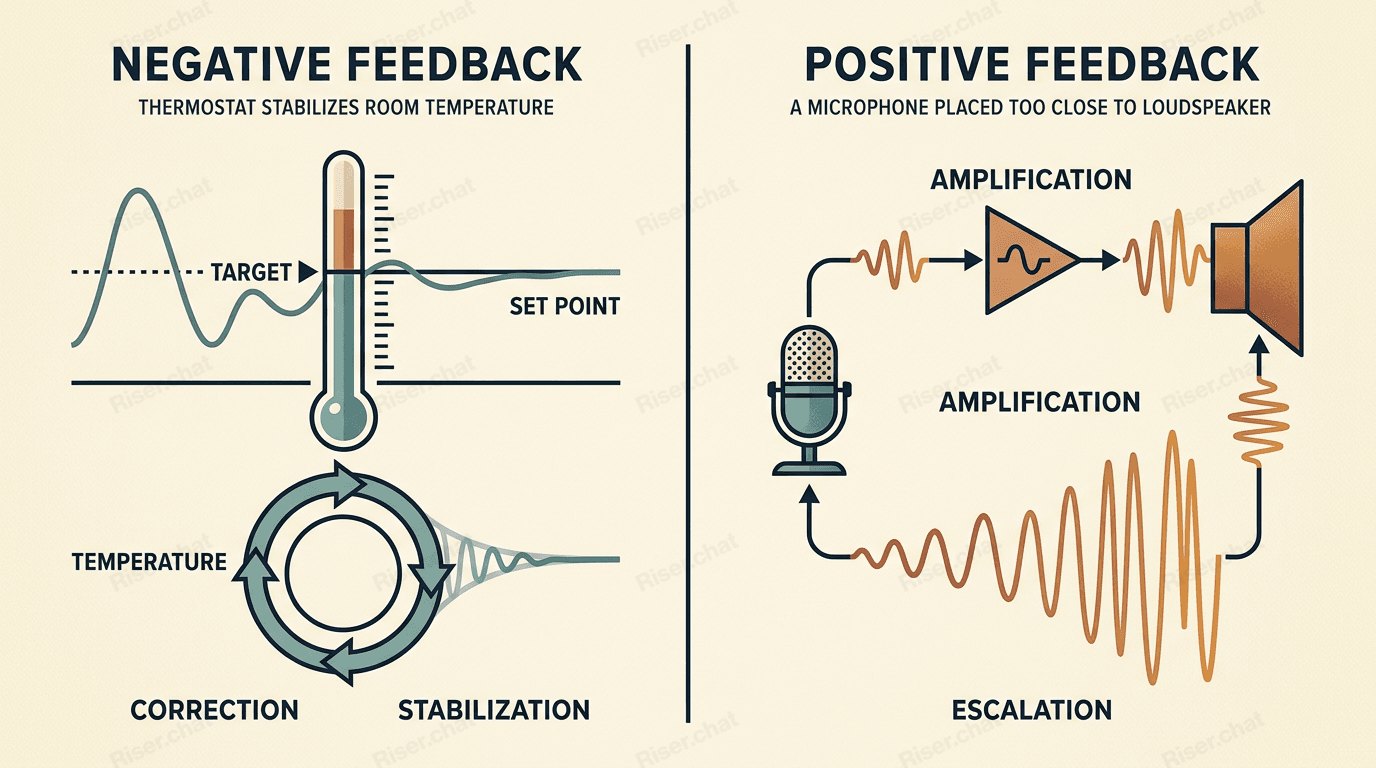
In cybernetics, negative does not mean harmful, and positive does not mean beneficial. The words describe how feedback affects an ongoing change.
Negative feedback
Negative feedback reduces the difference between the current state and the target.
Examples include:
- a thermostat reducing heat after the desired temperature is reached;
- an autopilot correcting a deviation from the intended course;
- the body using perspiration to regulate temperature;
- a camera adjusting focus;
- a robot correcting the position of a gripper.
Negative feedback usually contributes to stability.
Positive feedback
Positive feedback amplifies an ongoing change.
Examples include:
- a microphone picking up sound from a nearby speaker and amplifying it repeatedly;
- falling prices causing panic sales, which produce further price declines;
- early engagement causing a platform to distribute a post more widely, generating additional engagement.
Positive feedback can support rapid growth or state changes, but it can also make a system unstable.
| Feedback type | Effect | Example |
|---|---|---|
| Negative | Reduces deviation and stabilizes the system | Thermostat |
| Positive | Amplifies change | Audio feedback |
| Combined | Balances amplification and stability | Biological and economic systems |
Machines, organisms, and control systems
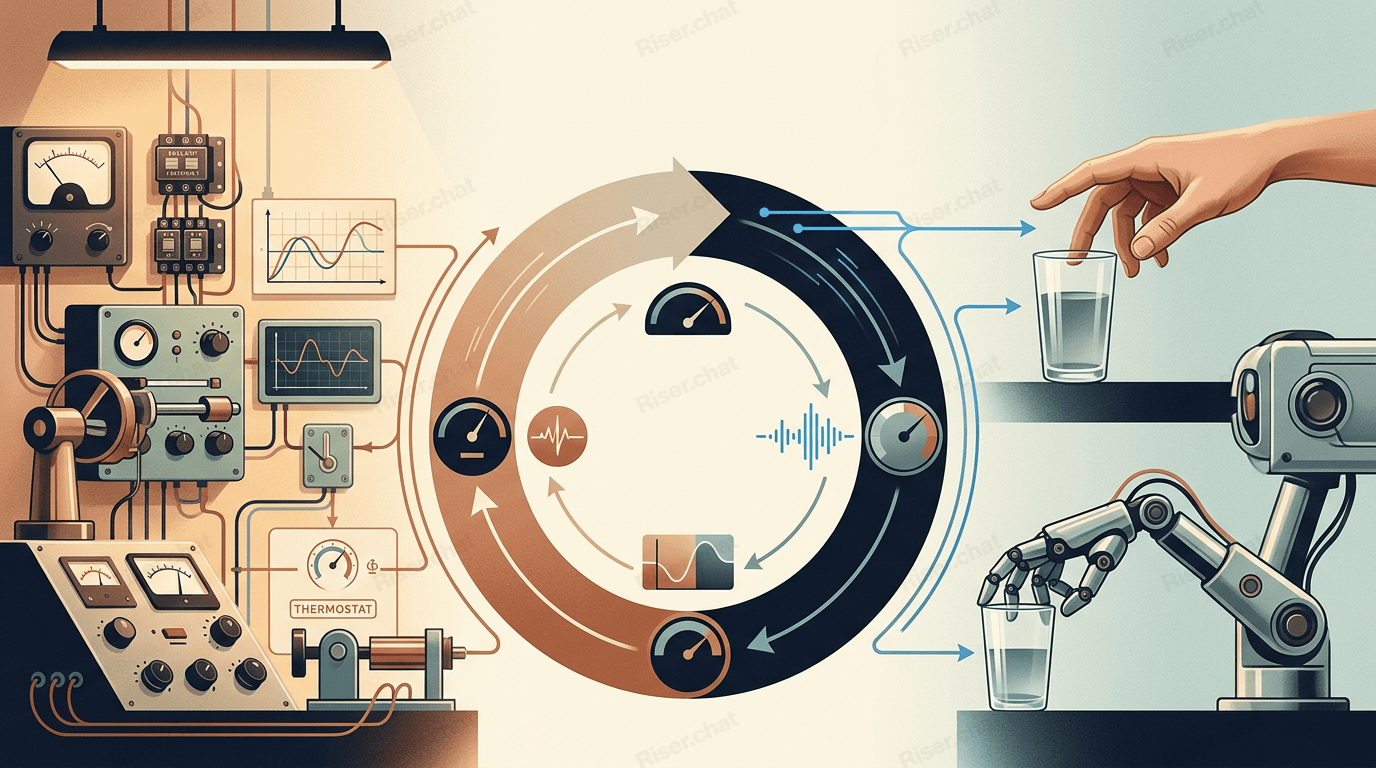
One of the boldest ideas of early cybernetics was that machines and living organisms could be studied within the same functional framework.
Cyberneticians did not claim that humans were literally mechanical devices. They focused on similarities in how different systems receive information and regulate behavior.
A living organism
An organism can:
- receive signals through its senses;
- transmit signals through the nervous system;
- process information;
- control muscles and organs;
- observe the effects of its actions;
- maintain internal stability;
- adapt to environmental changes.
A machine
An automatic machine can:
- collect data through sensors;
- transmit signals through communication channels;
- process those signals in a controller;
- operate motors or actuators;
- measure the result;
- maintain a target condition;
- adjust to changing circumstances.
A functional comparison
| Living organism | Technical system |
|---|---|
| Sensory organs | Sensors |
| Neural impulses | Electrical or digital signals |
| Brain and nervous system | Computer or controller |
| Muscles | Motors and actuators |
| Perception of results | Output measurement |
| Movement correction | Control command |
| Internal regulation | Automatic stabilization |
The 1943 paper by Rosenblueth, Wiener, and Bigelow examined objects through the relationship between input and output. This allowed purposeful behavior in organisms and machines to be discussed using a shared vocabulary.
Information, communication, and noise
A system cannot control what it cannot observe.
An autonomous vehicle needs information about:
- its own position;
- its speed and direction;
- road boundaries;
- nearby objects;
- its destination.
If the information is delayed, incomplete, or corrupted, the resulting action may be wrong.
Cybernetics therefore paid close attention to:
- signals;
- communication channels;
- information sources;
- message encoding;
- noise and interference;
- transmission speed;
- data storage;
- information processing.
A signal does not need to carry a large amount of energy to have a significant effect. A small electrical impulse may activate a powerful motor, stop a production line, or change the course of an aircraft.
The early Soviet cybernetics paper The Main Features of Cybernetics emphasized that the effect of information should not be confused with the energy used to transmit it. A low-energy message can produce a large change in a receiving system.
Why cybernetics was broader than artificial intelligence
Cybernetics is sometimes described as an old name for artificial intelligence. This is misleading.
Artificial intelligence focuses on building systems that perform tasks associated with perception, language, learning, reasoning, planning, and decision-making.
Cybernetics asks a broader question:
How does a system use information and feedback to control its behavior?
A cybernetic system does not need to appear intelligent.
Examples include:
- a temperature regulator;
- an aircraft stabilizer;
- a biological homeostatic mechanism;
- a production control system;
- a guidance mechanism;
- a robotic arm.
Most of these systems would not be classified as AI today.
At the same time, an AI model does not always form a complete cybernetic loop. A language model may receive a prompt and produce an answer without directly measuring how that answer changes the external world.
Cybernetics and AI overlap when an intelligent system perceives an environment, takes action, observes the result, and changes its behavior.
Cybernetics vs computer science
Cybernetics and computer science overlap, but they focus on different questions.
Computer science
Computer science studies:
- algorithms;
- computation;
- programming;
- data structures;
- software;
- databases;
- computer networks;
- information processing;
- automated problem-solving.
Its central concern is how information can be represented and processed computationally.
Cybernetics
Cybernetics studies:
- control;
- communication;
- feedback;
- goal-directed behavior;
- stability;
- adaptation;
- interactions between a system and its environment.
Its central concern is how a system regulates its behavior through information.
A practical example
An algorithm calculates the ideal conditions for a greenhouse. That calculation belongs largely to computer science.
Sensors measure temperature and humidity, a controller activates heating and ventilation, and new measurements determine the next action. This closed control process can be analyzed cybernetically.
| Field | Central question | Example |
|---|---|---|
| Cybernetics | How does a system regulate behavior through information and feedback? | Autopilot |
| Computer science | How can information be represented and processed? | Routing algorithm |
| Control theory | How can a dynamic process be controlled mathematically? | Drone stabilization |
| Artificial intelligence | How can tasks associated with intelligence be automated? | Object recognition |
| Machine learning | How can systems learn patterns from data? | Image classification |
| Robotics | How can machines perceive and act in the physical world? | Mobile robot |
In the Soviet Union, cybernetics became a broad label for computing, information processing, automation, and control. From the late 1970s onward, much of this role shifted to the term informatics.
How cybernetics influenced computing
Cybernetics was not simply another word for computing. A computer can perform calculations without controlling a physical process or receiving environmental feedback.
However, computers and cybernetics developed alongside one another.
Computers made it possible to:
- process signals quickly;
- model complex systems;
- calculate control actions;
- store past states;
- analyze sensor data;
- update commands automatically;
- implement adaptive algorithms.
Cybernetics encouraged researchers to see computers as more than fast calculators. A computer could become part of a control loop:
- receive data;
- compare the data with a target;
- calculate an action;
- issue a command;
- observe the new result;
- repeat the process.
The emergence of cybernetics at the same time as early electronic computing helped establish computers as tools for automation, simulation, communication, and control.
How cybernetics influenced robotics
A robot is an almost perfect illustration of a cybernetic system.
It may include:
- cameras;
- microphones;
- distance sensors;
- pressure sensors;
- navigation systems;
- a computer or controller;
- motors;
- manipulators;
- decision-making software.
The robot receives information from its surroundings, processes it, and acts. Its action changes the environment, producing new information.
A robotic vacuum, for example:
- measures the distance to a wall;
- selects a direction;
- begins moving;
- detects an obstacle;
- changes its route;
- measures its new position.
Without feedback, a robot could only replay a fixed sequence of movements. Sensors and closed-loop control allow it to respond to real conditions.
Modern robotics uses methods far more advanced than those available to early cyberneticians, but the cycle remains familiar:
perception → control → action → new perception.
How cybernetics is connected to machine learning
Cybernetics and machine learning are distinct fields, but they share an important idea: a system changes its behavior based on information about its results.
Supervised learning
During supervised learning, a model:
- receives an example;
- makes a prediction;
- compares the prediction with a target;
- calculates an error;
- updates its parameters;
- repeats the process.
This resembles a feedback loop:
prediction → error measurement → model update → new prediction.
The comparison should not be taken too literally. A thermostat regulates the current state of a physical process, while neural network training optimizes the parameters of a mathematical model.
The shared principle is more abstract: information about a discrepancy is used for correction.
Reinforcement learning
The connection is particularly clear in reinforcement learning.
An agent:
- observes the state of an environment;
- selects an action;
- receives a new state;
- receives a reward or penalty;
- updates its strategy;
- continues interacting.
The standard reinforcement learning framework represents an agent and environment as a repeated cycle of states, actions, and rewards.
Structurally, this resembles a cybernetic loop, although modern reinforcement learning has its own mathematical foundations and belongs primarily to machine learning.
How cybernetics is connected to neural networks
The relationship between cybernetics and neural networks can be understood at several levels.
1. A shared interest in the nervous system
Early cyberneticians wanted to identify general principles connecting brains, sensory organs, muscles, communication systems, and automatic machines.
McCulloch and Pitts demonstrated that a highly simplified neuron could be represented mathematically. Networks of these units could perform logical operations.
Cybernetics helped place such models within a broader discussion about information, brains, machines, and goal-directed behavior.
2. Error-based correction
During training, a neural network produces a prediction. A loss function measures the difference between that prediction and the target.
The training algorithm uses this information to change the network’s weights. In backpropagation, error-related signals are propagated from later layers toward earlier layers to calculate parameter updates.
This process can be explained using the general idea of feedback, but the two concepts are not identical:
Backpropagation is a specific mathematical optimization algorithm. Cybernetic feedback is a broader principle of control based on information about results.
Neural network training was not simply derived from Wiener’s thermostat-like feedback model. The connection is conceptual rather than a direct equivalence.
3. Adaptation
Cybernetics studied systems that could remain effective as conditions changed.
Machine learning addresses a related problem at another level. A model modifies its parameters based on data so that it can perform a target function more effectively.
4. Interaction with an environment
A standalone neural network may simply transform an input into an output. When it becomes part of a robot or an autonomous software agent, a broader loop emerges:
environmental data → neural network → decision → action → environmental change → new data.
The neural network then becomes one component of a cybernetic control system.
A neural network is not the same as a cybernetic system
A neural network is a mathematical model made of connected computational units and adjustable parameters.
A cybernetic system is a broader structure that may include:
- a goal;
- a controlled process;
- sensors;
- communication channels;
- a controller;
- actuators;
- feedback;
- an external environment.
A neural network may serve as one part of that structure.
In a self-driving vehicle, for example, a neural network may recognize pedestrians in camera images. The complete control system also includes:
- collecting camera and radar data;
- estimating the situation;
- planning a route;
- steering;
- braking or accelerating;
- measuring the vehicle’s new position;
- observing the environment again.
The neural network is therefore not the entire cybernetic system. It is one possible mechanism for processing information or selecting actions.
Cybernetics in the Soviet Union
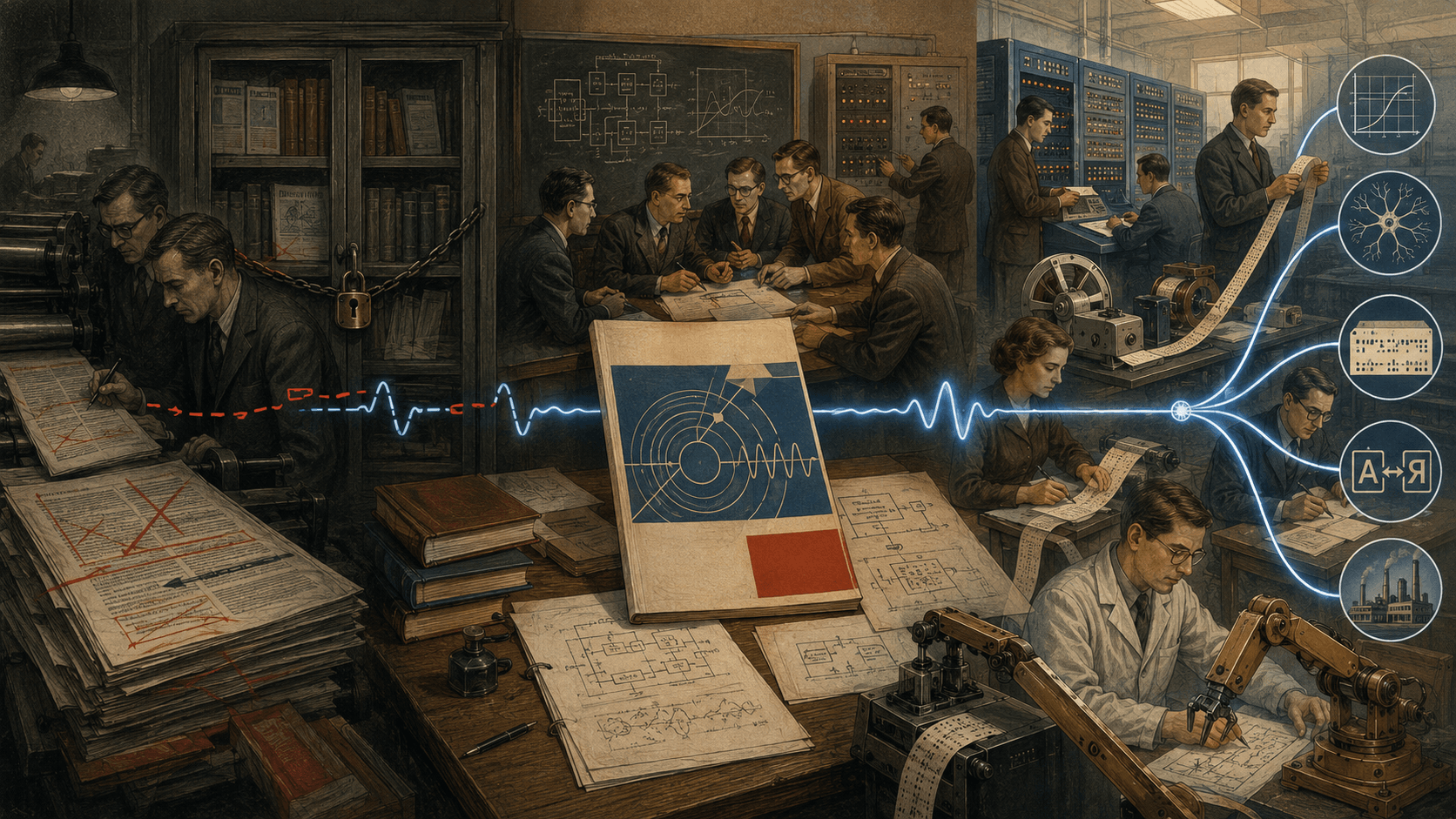
The history of Soviet cybernetics is more complicated than the popular story that the field was simply banned and later permitted.
Early criticism
In the early 1950s, Soviet publications attacked cybernetics as an idealist or reactionary doctrine. It was associated with American military technology, exaggerated claims about “thinking machines,” and attempts to reduce human beings to mechanisms.
Historical research indicates, however, that public ideological criticism did not stop work on computing, communications, and automatic control. Applied projects continued, particularly in military and engineering institutions. (web.mit.edu)
The label and philosophical claims were attacked more strongly than many of the underlying technologies.
The Main Features of Cybernetics
A major turning point came in 1955, when Sergei Sobolev, Anatoly Kitov, and Alexey Lyapunov published The Main Features of Cybernetics in the journal Voprosy Filosofii.
The authors presented cybernetics as a legitimate field concerned with information, electronic computers, programming, control, and communication in machines and organisms.
In 1959, the Soviet Academy of Sciences established a Scientific Council on Cybernetics under Aksel Berg. During the 1960s, cybernetics became a highly influential umbrella term covering technical, biological, medical, economic, and linguistic research.
Many of these areas later became independent disciplines under names such as computer science, informatics, AI, robotics, and control theory.
Why cybernetics still matters
During the second half of the twentieth century, the broad cybernetic movement separated into more specialized fields:
- computer science;
- artificial intelligence;
- control theory;
- robotics;
- information theory;
- systems analysis;
- cognitive science;
- machine learning;
- complexity research.
The word became less common, but its central questions remained relevant:
- How does an agent interact with its environment?
- How does a system maintain stability?
- How can feedback guide behavior?
- How should perception and action be connected?
- How can autonomous machines be controlled?
- How should humans interact with adaptive systems?
- How can unintended behavior be detected and corrected?
Cybernetic ideas are especially visible in robotics, brain–computer interfaces, autonomous control, and adaptive systems. Current research increasingly combines feedback, machine learning, neural interfaces, and physical interaction — areas that early cybernetics attempted to study within one framework.
Core principles of cybernetics
1. Control requires information
A system needs information about itself and its environment.
2. Results must be measured
Without measurement, the system cannot know whether it is approaching its target.
3. Feedback enables correction
Information about an outcome returns to the system and influences future behavior.
4. Similar principles can appear in different systems
Feedback can be found in a thermostat, an organism, a robot, or an organization, even though these systems are physically different.
5. Goal-directed behavior does not require consciousness
An autopilot can maintain a course without being conscious. A goal may be defined by the system’s design or programming.
6. Stability matters more than executing one command
A useful control system must continue functioning despite disturbances and changing conditions.
7. A system and its environment form a loop
Behavior cannot be fully understood without considering what the system acts upon and where its next inputs come from.
A brief timeline of cybernetics
| Year | Event |
|---|---|
| 1830s | André-Marie Ampère uses a related term for the study of government |
| 1943 | Rosenblueth, Wiener, and Bigelow publish their paper on behavior, purpose, and feedback |
| 1943 | McCulloch and Pitts introduce a mathematical neuron model |
| 1948 | Norbert Wiener publishes Cybernetics |
| 1948 | Claude Shannon publishes his foundational work on communication theory |
| 1950 | Wiener publishes The Human Use of Human Beings |
| 1955 | Sobolev, Kitov, and Lyapunov publish The Main Features of Cybernetics |
| 1959 | The Soviet Academy of Sciences establishes its Scientific Council on Cybernetics |
| 1960s | Cybernetics becomes a broad interdisciplinary movement |
| 1970s–1980s | Many cybernetic research areas develop into independent disciplines |
| 21st century | Feedback principles remain central to robotics, autonomous systems, machine learning, and neural interfaces |
Key people and their contributions
| Researcher | Major contribution |
|---|---|
| Norbert Wiener | Unified control, communication, and feedback in modern cybernetics |
| Arturo Rosenblueth | Helped develop a shared framework for studying organisms and machines |
| Julian Bigelow | Contributed engineering knowledge about control and purposeful behavior |
| Claude Shannon | Developed mathematical information and communication theory |
| Warren McCulloch | Connected neuroscience with mathematical modeling |
| Walter Pitts | Co-created a logical model of an artificial neuron |
| W. Ross Ashby | Studied adaptation, stability, and self-regulating systems |
| Anatoly Kitov | Promoted computing and cybernetics in the Soviet Union |
| Alexey Lyapunov | Helped establish Soviet cybernetics and programming research |
| Sergei Sobolev | Co-authored a key Soviet paper defending cybernetics |
| Aksel Berg | Led the Soviet Academy’s Scientific Council on Cybernetics |
Frequently asked questions
What is cybernetics in simple terms?
Cybernetics studies how a system receives information, makes a control decision, takes action, and uses the result to decide what to do next. A thermostat is a basic example.
Who is the founder of cybernetics?
Norbert Wiener is commonly called the founder of modern cybernetics. His 1948 book united ideas from mathematics, engineering, communication, physiology, and control. The field itself was created through the work of many researchers.
What is the central idea of cybernetics?
Feedback is one of its central ideas. Feedback means obtaining information about the result of an action and using it to modify future actions.
What is the difference between cybernetics and computer science?
Computer science primarily studies computation, algorithms, and information processing. Cybernetics primarily studies control, feedback, adaptation, and the behavior of systems interacting with an environment.
Are cybernetics and artificial intelligence the same?
No. Cybernetics covers control and communication in intelligent and non-intelligent systems. AI focuses on automating functions associated with perception, language, learning, reasoning, and planning.
How is cybernetics related to neural networks?
Both fields involve correction based on results. A neural network produces predictions, receives information about errors, and changes its parameters. Neural networks can also serve as components in feedback-based robotic or autonomous systems.
Is backpropagation a type of cybernetic feedback?
They are conceptually related but not identical. Backpropagation is a mathematical method for calculating gradients and updating neural network parameters. Cybernetic feedback is a general principle for regulating systems using information about outcomes.
Is cybernetics still used today?
Yes, although the term itself is less common. Its principles remain important in control theory, robotics, biology, autonomous systems, machine learning, brain–computer interfaces, and complexity research.
Conclusion
Cybernetics began as an attempt to discover common principles of control in machines, living organisms, and other complex systems.
Its central idea was feedback: a system should not merely execute a command. It should receive information about the result and adjust its future actions.
Norbert Wiener united research on control, communication, probability, physiology, and computing in one scientific program. Cybernetics gave researchers a shared way to discuss thermostats and nervous systems, machines and organisms, signals and decisions.
The broad cybernetic movement later separated into computer science, control theory, artificial intelligence, robotics, and machine learning. Its essential questions, however, are still with us:
- How does a system obtain information?
- How does it select an action?
- How does it measure the result?
- How does it correct errors?
- How does it adapt?
The same general logic can be seen in modern neural networks. During training, a model compares its prediction with a target and adjusts its parameters. When a neural network controls a robot or autonomous agent, it becomes part of a larger loop connecting perception, action, and feedback.
The next major step in neural network history came in 1943, when Warren McCulloch and Walter Pitts transformed a biological neuron into a mathematical model.
That model is the subject of the next article: “The First Artificial Neuron: The McCulloch–Pitts Model.”
Modern AI models process context, follow instructions, and generate answers in different ways. Riser lets users work with GPT, Claude, Gemini, and other models in one interface and compare their responses on real tasks.
Sources and further reading
-
Sergei Sobolev, Anatoly Kitov, and Alexey Lyapunov — The Main Features of Cybernetics
-
Russian Academy of Sciences — materials on the history of cybernetics and informatics
-
Norbert Wiener — Cybernetics: Or Control and Communication in the Animal and the Machine
-
Arturo Rosenblueth, Norbert Wiener, and Julian Bigelow — Behavior, Purpose and Teleology
-
IEEE — Open-loop systems
-
Richard Sutton and Andrew Barto — Reinforcement Learning: An Introduction
-
Nature Communications — research related to backpropagation and error signals
-
Nature Machine Intelligence — research connecting cybernetics, robotics, and neural interfaces
-
Slava Gerovitch — historical research on the development of Soviet cybernetics